

Domiciliary care is delivered in thousands of homes every single day, often by teams working under immense pressure to provide safe, compassionate and consistent support. When care and support is commissioned by local authorities, it must be monitored to ensure that people receive the quality and protection they deserve. Yet, for many providers, the quality monitoring landscape can feel crowded. Alongside CQC inspections, the Provider Assessment and Market Management Solution (PAMMS) is sometimes viewed as just one more layer of scrutiny, another process to prepare for, another set of expectations to meet.
What is the Provider Assessment and Market Management Solution (PAMMS)?
PAMMS is a local authority quality assurance tool designed to evaluate service quality and support continuous improvement. While it provides an assessment of quality, PAMMS also functions as a developmental tool, helping to identify areas where providers may benefit from support from the PAMMS or commissioning team and offering a reference point for ongoing improvement.
For some providers, meeting these requirements can pose logistical challenges, especially when evidence is scattered across systems or reliant on manual processes. But, the story doesn’t have to be one of additional burden. Many providers are increasingly turning to digital tools to monitor care quality, streamline documentation and provide clear, real‑time evidence to commissioners. When used well, PAMMS, supported by the right digital tools can do far more than help providers ‘stay compliant’.
In home care, bespoke technology can strengthen quality, streamline processes and showcase the excellent work teams deliver every day. Instead of feeling like yet another inspection hurdle, technology transforms PAMMS into a smarter, more efficient way of working, freeing providers to focus their time and energy where it matters most, demonstrating strengths, highlighting progress focusing on improvement efforts where they matter most and ultimately delivering outstanding care.
Compliance and how technology makes it possible
For many domiciliary care providers, compliance isn’t just a box to tick, it’s a daily operational challenge. Some services struggle under the weight of paperwork and fragmented systems. Others are turning to technology to monitor care quality, strengthen oversight and provide the evidence commissioners expect. The truth is that home care is uniquely complex and unlike residential settings, providers are not managing care under one roof. They’re managing:
- A dispersed workforce
- Limited direct supervision
- Real‑time decision making in the community
- And yet, providers still expected to deliver and evidence consistent, high‑quality, person‑centred care at every single visit.
The domiciliary dilemma: Care happens remotely, evidence must be centralised
PAMMS expectations don’t change just because care is delivered in people’s homes. But the difficulty of meeting those expectations absolutely does.
You still need clear, reliable evidence of:
- Person‑centred care at every visit
- Service user involvement
- Evidencing consent
- Safe medication practices
- Effective risk management
- Continuity and responsiveness
- Outcomes that reflect real impact
Yet, in home care, this evidence is often:
- Scattered across paper notes or disconnected systems
- Written after visits instead of during them
- Hard for managers to oversee in real time
This creates a critical gap:
You may be delivering excellent care, but how do you prove it?
Why traditional approaches don’t work in home care
Many providers still rely on:
- Legacy systems can make it difficult to evidence compliance for PAMMS
- Manual rostering
- Manual monitoring of visits
- Manual audits and spot checks
In a domiciliary environment, this leads to:
- Gaps in documentation
- Inconsistencies between carers
- Limited visibility for managers
- Increased pressure during PAMMS assessments
How CareLineLive supports care delivery where it happens
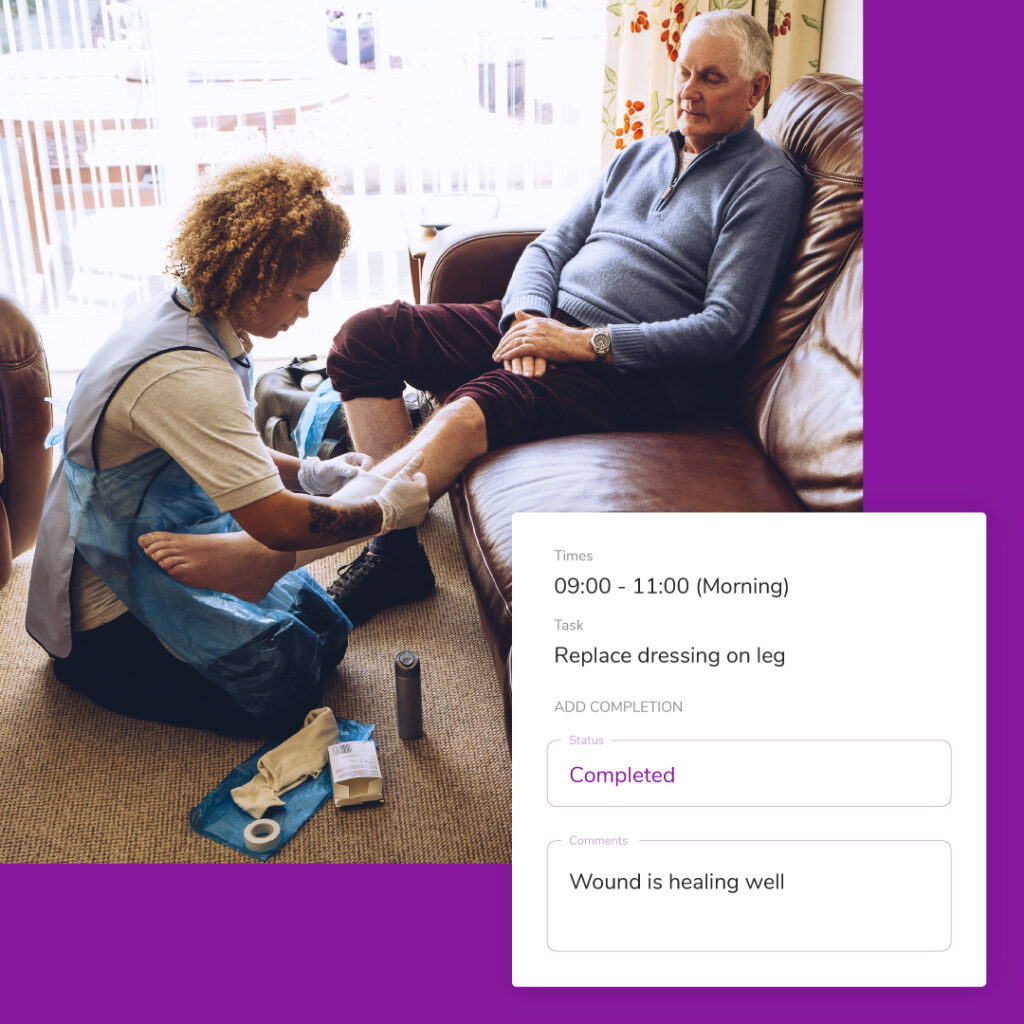
CareLineLive is designed for the realities of home care, where everything happens on the move. For managers and their teams, this unlocks something home care often lacks, live visibility across every visit.
- Managers can:
- Monitor care as it happens
- Spot missed tasks or risks immediately
- Ensure consistency across your entire service
- This directly supports PAMMS domains around safety, responsiveness and effective care delivery.
Turning daily visits into defensible evidence
PAMMS doesn’t just ask what happened, it asks:
- Was the person involved?
- Was care personalised?
- Were outcomes achieved?
CareLineLive structures records so they:
- Reflect individual preferences and routines
- Show active participation and consent
- Link care delivered to meaningful outcomes
Routine visit logs become inspection‑ready evidence.
How MOA Benchmarking improves oversight of a dispersed workforce
Capturing data is only half the challenge. The real question is:
How do you maintain oversight when your team is everywhere?
MOA Benchmarking provides:
- Structured audits
- Clear visibility of performance across the service
- Early identification of trends, risks and inconsistencies
- Action plans that plan for continuous improvement
In home care, this level of oversight is essential, issues can otherwise go unnoticed until they escalate.
From reactive spot checks to proactive quality assurance
Traditional monitoring methods, spot checks, supervisions, routine audits, may only offer snapshots.
By combining CareLineLive with MOA Benchmarking, providers shift to:
- Continuous monitoring
- Data‑driven insights
- Proactive improvement
This aligns perfectly with PAMMS expectations for well‑led, well‑governed services.
Creating consistency across every home
One of the biggest risks in domiciliary care is inconsistency:
- Different carers, different approaches
- Variations in documentation
- Inconsistent experiences for service users
With the right systems:
- Care plans are standardised while still personalised
- Recording is consistent across all staff
- Managers have full oversight of quality
The result?
Every client receives the same high standard of care, no matter who visits.
Beyond compliance: Building trust with commissioners
Local authorities rely on PAMMS to:
- Evaluate provider quality
- Monitor risk
- Inform commissioning decisions
Strong PAMMS performance demonstrates:
- Reliability across a dispersed workforce
- Effective leadership and oversight
- Consistent, person‑centred care
This builds trust and in a competitive market, trust drives referrals, contracts and growth.
Final thought: Make every visit count
In domiciliary care, every visit is a moment that matters. The question is:
Are you capturing those moments in a way that proves your service quality?
With CareLineLive and MOA Benchmarking:
- Care is recorded as it happens
- Quality is monitored continuously
- Evidence is always available
PAMMS stops being a stressful annual event and becomes a natural reflection of the outstanding care you deliver every day.
Empowering providers to deliver and evidence outstanding care
Working in domiciliary care means navigating one of the most complex, fast‑moving environments in the sector. Your teams travel from home to home, respond to people’s needs as they unfold and provide care that is personal, compassionate and deeply meaningful. You already deliver the hard work every day. What’s left is showing the impact you make.
CareLineLive and MOA Benchmarking are built to support providers like you by turning daily care activity into clear and consistent evidence. Together, they reduce administrative pressure, strengthen oversight and help you meet PAMMS expectations with confidence.
Most importantly, they give you the tools to demonstrate the quality you’re already delivering, visit by visit, home by home.
If you’re ready to simplify compliance, strengthen governance and showcase the quality of your service, now is the time to explore how digital tools can support your team.
We’re here to help you take the next step toward safer, smarter and more sustainable home care. To find out more simply follow this link.
Related content